Why Does Chrome Spin Forever Without Showing a Website?
When Chrome keeps loading but never opens a page, the cause is usually one of a handful of things: a corrupted browser cache, a server address lookup failure, a background sync or update process stuck mid-way, or a firewall quietly blocking the connection. The good news is that nearly all of them can be resolved without contacting your ISP, provided you check them in the right order.
This article explains the situations people search for most, including Chrome pages that won’t load but the internet works, a Chrome tab stuck spinning, Chrome loading some websites but not others, Chrome that stopped loading right after a browser update, a site that loads in other browsers but not Chrome, and Chrome showing an empty white tab. No matter if you use Windows, Chromebook, the same core checklist applies.
Root Causes Chrome Won’t Open Websites
Before jumping into fixes, it helps to understand where the loading process is breaking down. Loading a web page relies on a short chain of technical steps: Chrome sends a request to a DNS server to find where the website is hosted, then requests data from the remote server, runs any extensions or scripts attached to the tab, and finally renders the page’s files on your screen. If any single step in that chain stalls, the result is a page that never finishes opening that most people describe as “Chrome not opening at all.”
The usual suspects include: a bloated Chrome cache and cookies, a conflicting browser extension, a misconfigured DNS setting, antivirus software blocking rendering, a broken Chrome profile, and the target website’s own server being down or overloaded. Identifying which category the problem falls into makes the fix a lot easier.
Causes, Symptoms, and Quick Fixes for Chrome Stuck on Loading
| Possible Cause | What You’ll Notice | Recommended Action |
|---|---|---|
| Corrupted Chrome cache/cookies | One specific site won’t open, only in Chrome | Use a hard refresh (Ctrl+Shift+R) |
| Conflicting extension | Only certain pages get stuck loading | Turn off ad blockers temporarily |
| DNS lookup failure | “DNS_PROBE_FINISHED” or similar error appears | Flush DNS cache or switch to a public DNS like 8.8.8.8 |
| Chrome update didn’t finish | Chrome loads slowly only since the last update | Reinstall Chrome to the latest version |
| Firewall blocking Chrome | Site loads fine once VPN is off | Temporarily pause antivirus and test again |
| Website server is down | Other people report the same issue online | Wait and retry after some time |
8 EffectiveWays to Fix Chrome Stuck on Loading Screen
1. Reset Chrome’s Browsing Data
A bloated or outdated Chrome cache is one of the most common reasons a page gets stuck loading while other browsers work fine. Open chrome://settings/clearBrowserData, remove stored site data for the last 24 hours or all time, then restart Chrome completely before trying to open the site again.
2. Test the Site in Incognito Mode
Opening the page in Incognito mode is a fast way to rule out extension or cache-related problems. If the page opens fine in this mode, the issue is almost certainly related to an extension or stored site data, which explains why a site won’t load but other browsers work.
3. Turn Off Ad Blockers and Extensions
Ad blockers, VPN extensions, and privacy add-ons can accidentally interfere with essential parts of a website, leaving the tab stuck spinning forever. Turn each extension off individually, testing the site after disabling each to identify which add-on is responsible.
4. Switch to a Public DNS Server
Since the DNS server is what handles finding the website’s actual location on the internet, a failure at this step can make Chrome never finish loading a page even though other apps are online just fine. Try flushing your device’s DNS cache, which often resolves “Chrome loads some websites but not others” type problems.
5. Create a New Chrome Profile
Damaged local profile data inside Chrome can cause random loading failures that are hard to diagnose otherwise. Open Chrome’s People/Profile menu and add a new profile, then test the page again after the reset to see if the problem disappears.
6. Update Chrome to the Latest Version
An outdated Chrome build can fail to render modern websites correctly, causing them to hang or freeze, or the opposite can happen — an update stalls and breaks page loading, explaining why Chrome won’t load websites after an update. Check chrome://settings/help for a pending update, restart the browser, and retry.
7. Disable GPU Rendering in Chrome
Hardware acceleration is meant to speed up page loading on most systems, but on some graphics drivers it does the opposite, causing Chrome loading forever on Windows or a tab that stays stuck at a blank screen. Disable hardware acceleration in Chrome’s system settings, then restart Chrome and reload the page.
8. Review Security Software Rules
Security software sometimes over-blocks Chrome’s connections for a threat, quietly cutting the connection without any warning while leaving other browsers untouched. Temporarily disable real-time protection, reload the site in Chrome, and turn security back on right after testing.
9. End Chrome’s Background Processes and Relaunch
Sometimes, a leftover process silently locks up resources Chrome needs, which shows up as a browser that keeps spinning and won’t open websites. Fully close Chrome including background apps, then reopen it; if it still doesn’t help, uninstalling and reinstalling Chrome often resolves it for good.
10. Check Whether the Website’s Server Is Down
Occasionally, the fault lies entirely with the website itself — the site’s own server could be down or overwhelmed with traffic. Check a site-status checker to confirm whether the outage is affecting everyone, not just you and not just Chrome. If it is, the only real fix is to wait until the site comes back online.
Frequently Asked Questions About Chrome Stuck on Loading
Chrome keeps loading but the page never opens — what’s wrong?
This usually happens because of one of a handful of common causes: cached data, extensions, DNS problems, or a broken Chrome profile. Testing each cause one by one will typically reveal the exact source within a few minutes.
Chrome pages won’t load but the internet works — why?
An active internet connection doesn’t guarantee every part of the browser is working as it should. The connection itself can be fine while a DNS server, Chrome’s cache, or a stuck extension is what’s actually causing the delay.
How do I fix Chrome when it’s stuck loading?
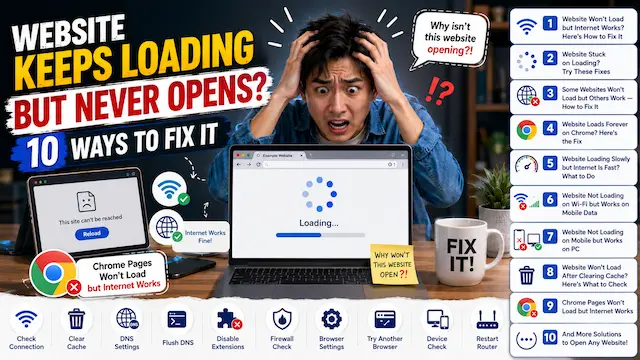
A reliable order to try is: clear the cache, test in Incognito, disable extensions, flush DNS, reset the profile, update Chrome, turn off hardware acceleration, check security software, and finally restart or reinstall Chrome. Going through them in this order fixes the vast majority of stuck-loading cases.
Why do only certain sites fail to open in Chrome?
When only certain websites are affected, your overall connection usually isn’t at fault — it’s more likely a DNS issue, a blocked domain from an extension or antivirus, or an issue specific to that site’s server.
Why won’t Chrome load websites after an update?
An update can sometimes leave leftover files or a half-applied change, which temporarily breaks page rendering until Chrome is relaunched. Fully closing and reopening Chrome, or resetting to default settings typically resolves the issue.
Why is Chrome loading forever on Windows specifically?
This usually points to outdated GPU drivers, leftover Chrome background tasks, or Windows-specific network settings. Turning off hardware acceleration and restarting fully resolves most of these cases.
A website isn’t loading in Chrome but works in other browsers — why?
This points to a Chrome-specific issue rather than a network problem — think a corrupted Chrome cache, a conflicting extension, or a broken Chrome profile specifically, because the connection itself is already proven to work.
Chrome keeps spinning and won’t open any websites — what should I do first?
Fully close Chrome, including background tasks, then reopen it, since a stuck background process is a common cause of a browser that won’t respond at all. If that doesn’t help, try flushing DNS and disabling extensions next.
Chrome shows an empty white tab instead of loading the site — why?
A blank page usually means the connection to the server was made but the content failed to render, often because of a broken extension, hardware acceleration issues, or a corrupted cache. Testing in Incognito mode and clearing cached data fixes the majority of blank-page issues.
Conclusion
Chrome that keeps loading but never opens a page is annoying, but in the vast majority of cases fixable once you check the right things in order. Start with the simplest fixes, then work your way through extensions, DNS, hardware acceleration, and security settings before assuming the problem is on the website’s end. Using this checklist, the large majority of these problems can be resolved without needing to reinstall Windows or contact support at all.