
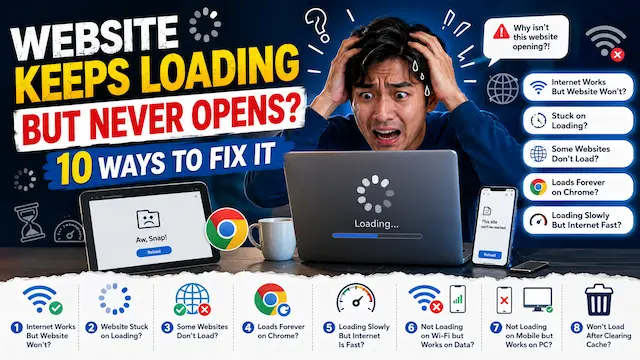
Why Is Your Web Page Get Stuck Without Opening?
If a website won’t load even though the WiFi icon shows full bars, the cause is usually one of a handful of things: a browser-side issue, a DNS failure, an overloaded hosting server, or a firewall filtering the connection. The reassuring part is that most of these causes can be fixed in under five minutes, provided you know what to test first.
This article breaks down every common scenario, including a website stuck on loading, a website loading slowly even though the internet is fast, a site that loads on mobile data but not WiFi, and a page that stopped loading right after clearing the cache. Whether you’re on Chrome, Edge, or a phone browser, these steps work across almost every browser and device.
Typical Reasons a Page Won’t Open
Before changing any settings, it helps to recognize what’s actually happening behind the scenes. A page load relies on a short chain of technical steps: your browser asks a DNS server to find where the website is hosted, then requests data from the website’s hosting server, which returns the content to be displayed on your screen. If a request gets stuck anywhere along the way, the result is a page that never finishes opening that most people describe as “not opening at all.”
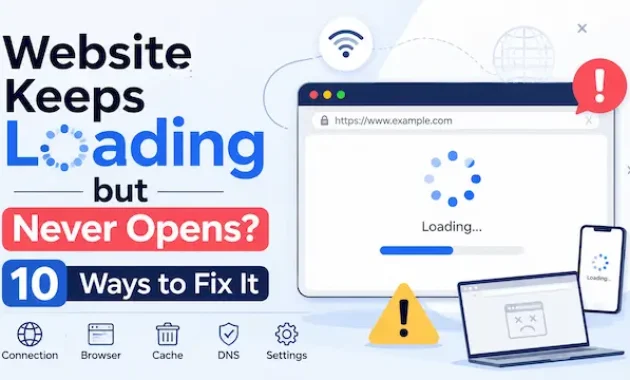
The usual suspects include: corrupted browser cache and cookies, an inconsistent WiFi signal, DNS server issues, third-party browser extensions interfering with the connection, an outdated browser version, and temporary downtime on the site you’re trying to reach. Pinpointing which category the problem falls into makes the fix much faster.
Problem-to-Solution Comparison for a Page Stuck on Loading
| Possible Cause | What You’ll Notice | Quick Fix |
|---|---|---|
| Corrupted cache/cookies | One specific site won’t open on this browser | Use a hard refresh (Ctrl+Shift+R) |
| DNS lookup failure | Some sites load, others never do | Flush DNS cache or switch to a public DNS like 8.8.8.8 |
| Unstable network connection | Works fine on mobile data but not WiFi | Restart the router/modem, move closer to it |
| VPN or proxy interference | Only certain sites are blocked | Temporarily pause antivirus and test again |
| Outdated browser version | Problem appears only in one specific browser | Disable extensions one by one |
| Site overloaded with traffic | The site fails to load on every device and network | Wait and retry after some time |
9 SimpleWays to Fix a Website That Keeps Loading but Never Opens
1. Reset Browser Cache and Cookies
An overloaded or corrupted browser cache is often the first reason a single site refuses to load even when your internet connection is perfectly normal. Go to your browser settings, remove stored site data, then reload the page completely to see if it opens normally.
2. Restart Your Router or Modem
A simple router restart resets the connection to your ISP that frequently lead to a website loading slowly or not loading at all. Unplug the router for about 30 seconds, then turn it on again and give it a minute to reconnect before retrying the site.
3. Flush or Change Your DNS Settings
Because the DNS server is responsible for finding the website’s actual location on the internet, a failure at this step can make a site seem to load forever even though the website is actually up. Try flushing your device’s DNS cache, which often resolves inconsistent loading between different sites.
4. Open the Page in a Private Window
Loading the site through Incognito/Private mode is a fast way to rule out extension or cache-related problems. If the site loads normally here, you’ve confirmed the problem sits with your regular browser profile, not your network.
5. Turn Off Ad Blockers and Extensions
Ad blockers, VPN extensions, and privacy add-ons can accidentally interfere with scripts a page needs to finish loading, leaving it stuck at “loading” forever. Turn each extension off individually and reload the page after each one to find the exact extension causing the conflict.
6. Disconnect from VPN Temporarily
A VPN or proxy connection can sometimes conflict with certain websites’ security systems, resulting in a page that never fully opens. Disconnect the VPN for a moment and see whether the page opens normally without it.
7. Review Security Software Rules
Security software can occasionally mistake a safe site for a risky one, silently preventing the page from loading. Temporarily disable real-time protection, test the page again, and turn security back on right after testing.
8. Compare WiFi and Mobile Data Results
When the page only fails on one type of connection, the problem is network-specific, not the website itself. Toggle WiFi off and use mobile data to test whether the same page opens without WiFi involved; this also helps explain why a website loads on mobile but not on PC, or the other way around.
9. Update Your Browser to the Latest Version
An outdated browser can fail to render pages built with newer web technologies, leaving them stuck mid-load. Make sure automatic updates are turned on, and if problems persist even after updating, consider reinstalling the browser entirely.
10. Check Whether the Website’s Server Is Down
Sometimes the problem isn’t on your end at all — the site’s own server could be down or overwhelmed with traffic. Check a site-status checker to confirm whether the outage is affecting everyone, not just you. If it is, the only real fix is to wait until the site comes back online.
Frequently Asked Questions About Pages Stuck on Loading
Why is my page stuck loading forever?
This usually happens because of one of a handful of common causes: cached data, DNS problems, security software interference, or server-side downtime. Working through the checklist above in order usually identifies the exact source within a few minutes.
Why won’t a website load even though the internet works fine?
An active internet connection doesn’t guarantee the DNS server, the website’s host, and your browser are all functioning correctly. The connection itself can be fine while one specific link in the chain is the real bottleneck.
Why do some websites load but others don’t?
When only certain websites are affected, the cause is rarely your general internet connection — it typically points to DNS resolution, security software rules, or a problem on that particular website’s end.
Why does a website load slowly even though the internet speed is fast?
High internet speed doesn’t guarantee quick website loading, because loading time also depends on server response speed, page size, and background processes running on your device.
Why does a website work on WiFi but not mobile data, or the other way around?
Each network uses a different DNS provider and routing path, so a block or DNS problem on one network won’t always show up on the other. Comparing results between the two is a fast way to tell whether the issue is tied to a particular connection or device-specific.
Why does the site open on my phone but not my computer?
Since it works on one device and not the other, the network usually isn’t to blame — check the browser version, cached data, and security settings on whichever device is having trouble.
Why did my website stop loading right after I cleared the cache?
Clearing the cache also removes saved login sessions and site preferences, so a brief loading hiccup right after a cache clear is normal while the browser reloads everything fresh. If the problem continues beyond the first reload, check your DNS settings or try restarting the browser entirely.
Conclusion
A page stuck on “loading” forever is frustrating, but almost always solvable once you check the right things in order. Begin with clearing cache and restarting your router, then work your way through DNS, VPN, extensions, and firewall settings before concluding that the site itself is down. Using this checklist, the large majority of these problems are solvable without any technical background at all.