Why Is Google Chrome Keep Loading but Never Open the Page?
When Chrome keeps loading but never opens a page, it’s usually one of a small number of things: a corrupted browser cache, a DNS failure, a hardware acceleration bug, or a antivirus program silently interrupting the connection. The good news is that the majority of cases are solvable without contacting your ISP, so long as you know what to test first.
This guide explains the most common versions of this problem, including Chrome pages that won’t load but the internet works, a Chrome tab stuck spinning, Chrome refusing to open specific sites, Chrome that stopped loading right after a browser update, a site that won’t open in Chrome but works fine in Edge or Firefox, and Chrome opening a blank page instead of the website. No matter if you use Windows, Chromebook, the same core checklist applies.
Root Causes Chrome Won’t Open Websites
Before jumping into fixes, it helps to recognize where the loading process is breaking down. Opening a website in Chrome involves several steps: Chrome asks a DNS server to translate the domain name into an IP address, then requests data from the remote server, runs any extensions or scripts attached to the tab, and finally renders the content on your screen. If any single step in that chain stalls, the result is a page that never finishes opening that most people describe as “Chrome not opening at all.”
Among the most frequent culprits are: a corrupted Chrome cache and cookies, a conflicting browser extension, a misconfigured DNS setting, antivirus software blocking rendering, a broken Chrome profile, and the target website’s own server being down or overloaded. Narrowing down which category the problem falls into will make the fix a lot easier.
At-a-Glance Troubleshooting Table for Chrome Loading Problems
| Possible Cause | What You’ll Notice | Recommended Action |
|---|---|---|
| Full browser cache | One specific site won’t open, only in Chrome | Clear Chrome’s cache and cookies, then reload |
| Buggy ad blocker | Site loads fine in Incognito mode | Disable extensions one by one and retest |
| Outdated DNS cache | “DNS_PROBE_FINISHED” or similar error appears | Flush DNS cache or switch to a public DNS like 8.8.8.8 |
| Broken Chrome profile | Chrome loads slowly only since the last update | Reinstall Chrome to the latest version |
| Firewall blocking Chrome | Site loads fine once VPN is off | Temporarily pause antivirus and test again |
| Website server is down | The site fails to load in every browser, not just Chrome | Wait and retry after some time |
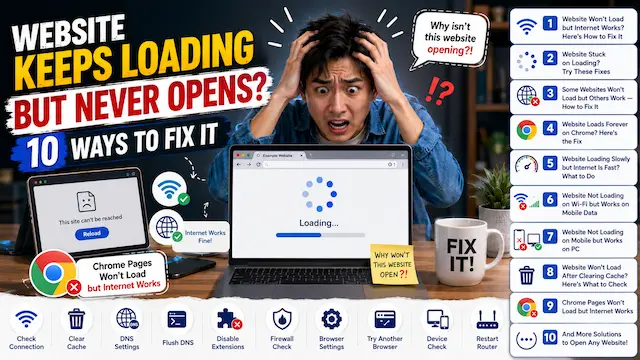
8 Ways to Fix Chrome Keeps Loading but Never Opens
1. Reset Chrome’s Browsing Data
A bloated or outdated Chrome cache is one of the most common reasons a single site refuses to load while other browsers work fine. Open chrome://settings/clearBrowserData, remove stored site data for the last 24 hours or all time, then reload the page completely to see if it opens normally.
2. Open the Page in a Private Window
Opening the page in Incognito mode disables extensions and skips cached data automatically. If the site loads normally here, the issue is almost certainly related to an extension or stored site data, which explains why a site won’t load but other browsers work.
3. Disable Extensions One by One
Ad blockers, VPN extensions, and privacy add-ons can accidentally interfere with scripts a page needs to finish loading, leaving the tab stuck spinning forever. Go to chrome://extensions and disable each one at a time, reloading the page after each one to identify the exact extension causing the conflict.
4. Flush or Change Your DNS Settings
Because the DNS server is responsible for finding the website’s actual location on the internet, a failure at this step can make Chrome seem to load forever even though other apps are online just fine. Try flushing your device’s DNS cache, which frequently fixes inconsistent loading between different sites.
5. Create a New Chrome Profile
A corrupted user profile inside Chrome can silently break page rendering that don’t show up as a clear error message. Go to chrome://settings/reset and reset settings to default, then test the page again after the reset to confirm whether the profile was the cause.
6. Check for a Pending Chrome Update
An outdated Chrome build can fail to render pages built with newer web technologies, causing them to hang or freeze, or the opposite can happen — a recent update finishes installing incorrectly and leaves Chrome half-broken, explaining why Chrome won’t load websites after an update. Check chrome://settings/help for a pending update, restart the browser, and retry.
7. Disable GPU Rendering in Chrome
GPU-based rendering speeds up page loading on most systems, but on some graphics drivers it does the opposite, causing Chrome loading forever on Windows or a tab that never finishes rendering. Disable hardware acceleration in Chrome’s system settings, then restart Chrome and reload the page.
8. Review Security Software Rules
Antivirus, firewall, or VPN tools sometimes over-blocks a safe site for a risky one, quietly cutting the connection without any warning while other apps continue to work fine. Pause the antivirus, firewall, or VPN briefly, test the page again, and re-enable protection immediately afterward.
9. Restart or Reinstall Chrome Completely
Sometimes, a leftover process silently locks up resources Chrome needs, leading to a browser that opens a blank page instead of the site. End all Chrome-related processes in Task Manager (or Activity Monitor on Mac), then relaunch; if it still doesn’t help, uninstalling and reinstalling Chrome often resolves it for good.
10. Check Whether the Website’s Server Is Down
Occasionally, the fault lies entirely with the website itself — the hosting server may be overloaded, under maintenance, or temporarily offline. Check a site-status checker to confirm whether the outage is affecting everyone, not just you and not just Chrome. In that case, there’s nothing to troubleshoot on your side except waiting.
FAQ About Chrome Loading Problems
Chrome keeps loading but the page never opens — what’s wrong?
In most cases this occurs because of one of a handful of common causes: cached data, extensions, DNS problems, or a broken Chrome profile. Testing each cause one by one will typically reveal the exact source fairly quickly.
Chrome pages won’t load but the internet works — why?
Just because your WiFi shows “connected” doesn’t mean Chrome itself is functioning correctly. Your internet may be perfectly stable while a DNS server, Chrome’s cache, or a stuck extension is what’s actually causing the delay.
Chrome is stuck on the loading screen — what are the 9 ways to fix it?
The fastest checklist is: clear the cache, test in Incognito, disable extensions, flush DNS, reset the profile, update Chrome, turn off hardware acceleration, check security software, and finally restart or reinstall Chrome. Going through them in this order fixes the vast majority of stuck-loading cases.
Why do only certain sites fail to open in Chrome?
If the problem is limited to specific sites, your overall connection usually isn’t at fault — it typically points to DNS resolution, security software rules, or a problem on that particular website’s end.
Chrome broke right after updating — what happened?
An update can sometimes leave leftover files or a half-applied change, which temporarily breaks page rendering until Chrome is fully restarted. Restarting your device, checking for a follow-up update, or resetting Chrome’s settings typically resolves the issue.
Why is Chrome loading forever on Windows specifically?
This is often tied to outdated GPU drivers, leftover Chrome background tasks, or Windows-specific network settings. Turning off hardware acceleration and restarting fully resolves most of these cases.
A website isn’t loading in Chrome but works in other browsers — why?
This points to a Chrome-specific issue rather than a network problem — check Chrome’s cache, extensions, and security settings specifically, because the connection itself is already proven to work.
Chrome keeps spinning and won’t open any websites — what should I do first?
Fully close Chrome, including background tasks, then reopen it, since a stuck background process is a common cause of a browser that won’t respond at all. If that doesn’t help, move on to clearing the cache and checking your network.
Chrome shows an empty white tab instead of loading the site — why?
A blank page usually means the connection to the server was made but the content failed to render, often because of a rendering conflict or damaged local data. Disabling extensions and hardware acceleration, then clearing the cache resolves this in most cases.
Conclusion
Chrome that keeps loading but never opens a page is frustrating, but in the vast majority of cases fixable once you check the right things in order. Begin with clearing cache and testing in Incognito, then work your way through extensions, DNS, hardware acceleration, and security settings before concluding that the site itself is down. With the steps above, most Chrome loading issues can be resolved without any technical background at all.