Why Does Google Chrome Spin Forever Without Showing a Website?
Whenever Chrome keeps loading but never opens a page, it’s usually one of a small number of things: a corrupted browser cache, a server address lookup failure, a hardware acceleration bug, or a antivirus program filtering the connection. Fortunately that most of these causes can be resolved without reinstalling anything, so long as you know what to test first.
The walkthrough below walks through every common scenario, including Chrome pages that won’t load but the internet works, a Chrome tab stuck spinning, Chrome loading some websites but not others, Chrome that stopped loading right after a browser update, a site that loads in other browsers but not Chrome, and Chrome opening a blank page instead of the website. No matter if you use Windows, Android, these steps work across almost every device running Chrome.
Typical Reasons Chrome Gets Stuck
Before changing any settings, it helps to understand what’s actually happening inside the browser. A page load in Chrome relies on a short chain of technical steps: Chrome sends a request to a DNS server to find where the website is hosted, then requests data from the website’s hosting server, runs any extensions or scripts attached to the tab, and finally displays the page’s files on your screen. If any single step in that chain stalls, the result is a page that never finishes opening that most people describe as “Chrome stuck loading.”
What typically causes this are: a corrupted Chrome cache and cookies, an outdated browser extension, DNS server issues, antivirus software blocking rendering, a broken Chrome profile, and the target website’s own server being down or overloaded. Identifying which category the problem falls into makes the fix far more targeted.
At-a-Glance Troubleshooting Table for Chrome Stuck on Loading
| Possible Cause | What You’ll Notice | Recommended Action |
|---|---|---|
| Corrupted Chrome cache/cookies | Chrome works on other devices but not this one | Use a hard refresh (Ctrl+Shift+R) |
| Conflicting extension | Site loads fine in Incognito mode | Disable extensions one by one and retest |
| Outdated DNS cache | “DNS_PROBE_FINISHED” or similar error appears | Flush DNS cache or switch to a public DNS like 8.8.8.8 |
| Chrome update didn’t finish | Chrome loads slowly only since the last update | Reinstall Chrome to the latest version |
| VPN, proxy, or antivirus interference | Chrome is blocked but other browsers aren’t | Temporarily pause antivirus and test again |
| Site overloaded with traffic | The site fails to load in every browser, not just Chrome | Check the site’s status on a service like Downdetector |
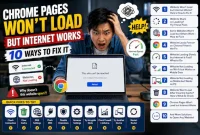
9 ProvenWays to Fix Chrome Keeps Loading but Never Opens
1. Clear Chrome’s Cache and Cookies
A bloated or outdated Chrome cache is often the first reason a page gets stuck loading even when your internet connection is perfectly normal. Go to Chrome Settings > Privacy and Security > Clear browsing data, clear cached images and files along with cookies, then reload the page completely to see if it opens normally.
2. Open the Page in a Private Window
Opening the page in Incognito mode disables extensions and skips cached data automatically. If the site loads normally here, the issue is almost certainly related to an extension or stored site data, which explains why a site won’t load but other browsers work.
3. Disable Extensions One by One
Ad blockers, VPN extensions, and privacy add-ons can mistakenly block scripts a page needs to finish loading, leaving the tab stuck spinning forever. Turn each extension off individually, testing the site after disabling each to identify which add-on is responsible.
4. Flush or Change Your DNS Settings
Because the DNS server is what handles translating a domain name into the correct server address, a failure at this step can make Chrome never finish loading a page even though the internet connection is working. Consider switching to a fast public DNS such as Google DNS (8.8.8.8) or Cloudflare (1.1.1.1), which frequently fixes “Chrome loads some websites but not others” type problems.
5. Create a New Chrome Profile
Damaged local profile data inside Chrome can cause random loading failures that don’t show up as a clear error message. Open Chrome’s People/Profile menu and add a new profile, then test the page again after the reset to see if the problem disappears.
6. Update Chrome to the Latest Version
Running an old browser version can struggle to load pages built with newer web technologies, causing them to hang or freeze, or the opposite can happen — an update stalls and breaks page loading, explaining why Chrome won’t load websites after an update. Check chrome://settings/help for a pending update, restart the browser, and retry.
7. Disable GPU Rendering in Chrome
Hardware acceleration speeds up page loading on most systems, but it can conflict with outdated or buggy drivers, causing Chrome loading forever on Windows or a tab that never finishes rendering. Disable hardware acceleration in Chrome’s system settings, then restart Chrome and reload the page.
8. Review Security Software Rules
Antivirus, firewall, or VPN tools sometimes over-blocks a safe site for a risky one, silently preventing the page from loading while leaving other browsers untouched. Pause the antivirus, firewall, or VPN briefly, reload the site in Chrome, and re-enable protection immediately afterward.
9. End Chrome’s Background Processes and Relaunch
Sometimes, a background Chrome process keeps running even after you close the browser, which shows up as a browser that keeps spinning and won’t open websites. Fully close Chrome including background apps, then reopen it; if the problem persists, a clean reinstall usually clears deeper corruption issues.
10. Confirm the Site Isn’t Down for Everyone
Occasionally, the fault lies entirely with the website itself — the site’s own server could be down or overwhelmed with traffic. Use a third-party tool like Downdetector or IsItDownRightNow to see if other users are reporting the same issue. If it is, the only real fix is to wait until the site comes back online.
FAQ About Chrome Loading Problems
Chrome keeps loading but the page never opens — what’s wrong?
In most cases this occurs because of one of a handful of common causes: cached data, extensions, DNS problems, or a broken Chrome profile. Working through the checklist above in order usually identifies the exact source within a few minutes.
Chrome pages won’t load but the internet works — why?
An active internet connection doesn’t guarantee Chrome itself is functioning correctly. Your internet may be perfectly stable while a DNS server, Chrome’s cache, or a stuck extension is what’s actually causing the delay.
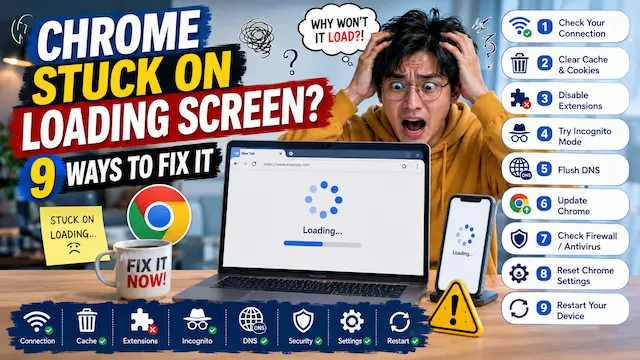
Chrome is stuck on the loading screen — what are the 9 ways to fix it?
The fastest checklist is: clear the cache, test in Incognito, disable extensions, flush DNS, reset the profile, update Chrome, turn off hardware acceleration, check security software, and finally restart or reinstall Chrome. Going through them in this order resolves the vast majority of stuck-loading cases.
Why does Chrome load some websites but not others?
When only certain websites are affected, your overall connection usually isn’t at fault — it’s more likely a DNS issue, a blocked domain from an extension or antivirus, or an issue specific to that site’s server.
Chrome broke right after updating — what happened?
An update can sometimes leave leftover files or a half-applied change, which can cause loading errors until Chrome is relaunched. Restarting your device, checking for a follow-up update, or resetting Chrome’s settings typically resolves the issue.
Why is Chrome loading forever on Windows specifically?
This usually points to a graphics driver conflict with hardware acceleration, background processes left running by Task Manager, or outdated Windows network drivers. Disabling GPU rendering and relaunching Chrome resolves most of these cases.
Why does the site open in Edge/Firefox but not Chrome?
This points to a Chrome-specific issue rather than a network problem — check Chrome’s cache, extensions, and security settings specifically, since the same network is clearly working for other browsers.
Why is Chrome completely stuck and unresponsive?
Fully close Chrome, including background tasks, then reopen it, since leftover processes are often what causes total unresponsiveness. If the problem continues, try flushing DNS and disabling extensions next.
Why does Chrome open a blank page instead of the website?
An empty tab typically indicates Chrome received a response but couldn’t display it, often because of a rendering conflict or damaged local data. Testing in Incognito mode and clearing cached data fixes the majority of blank-page issues.
Final Thoughts
Chrome that keeps loading but never opens a page is annoying, but in the vast majority of cases solvable once you know where to look. Start with the simplest fixes, then work your way through extensions, DNS, hardware acceleration, and security settings before concluding that the site itself is down. With the steps above, most Chrome loading issues are solvable without any technical background at all.